PDF to Markdown
● AI-extracted profile · Editorial review pending. Check the linked sources before relying on these details.
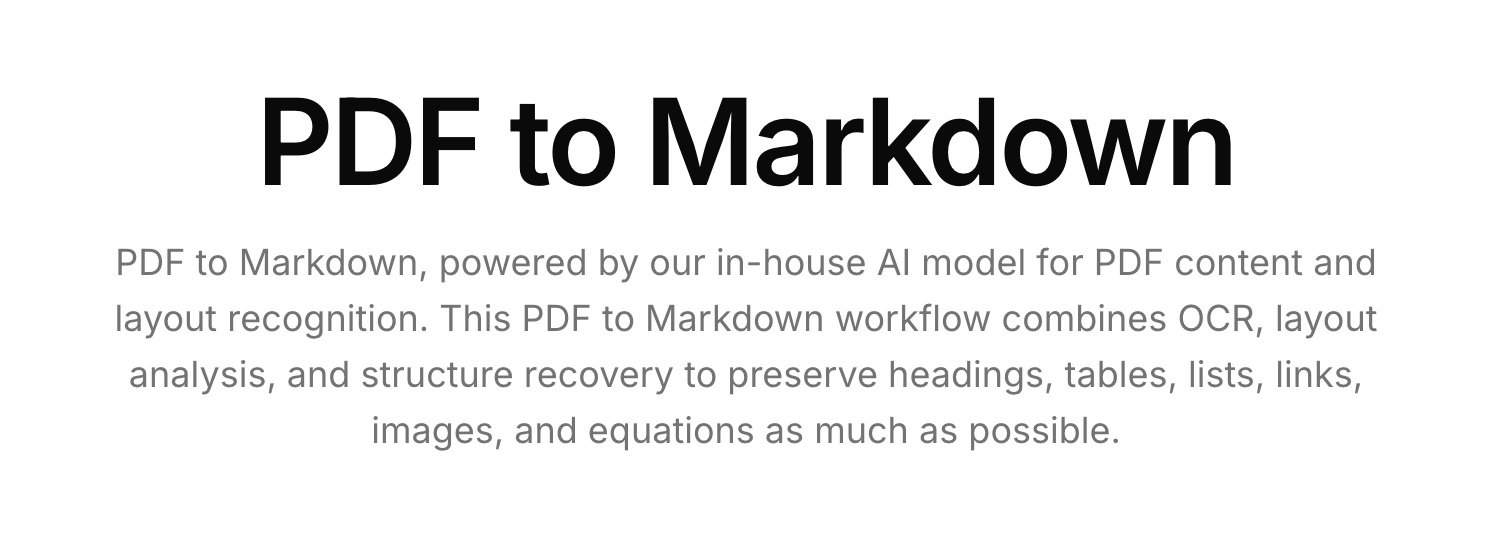
PDF to Markdown is an AI-powered web tool that converts PDF files into clean, editable Markdown with OCR, layout analysis, and structure recovery. Source ↗
What it does
- OCR and layout analysis to preserve document structure ↗
- Web batch upload with trial credits for new users ↗
- Public API supporting multipart PDF upload and remote URL ↗
- Fast, balanced, and precision processing modes with credit‑based pricing ↗
- Outputs include Markdown, JSON, and ZIP bundles with assets ↗
Founders
No founder identity verified from the sources reviewed.
Funding timeline
No verified public funding round found. This does not mean the company is unfunded.
In the news
No attributable press or commentary found in the sources reviewed.
Podcasts
Founder appearances, with public episode sources. An appearance may cover another company or a broader topic; it is not an endorsement.
No sufficiently attributable podcast appearance found in the sources reviewed. This is not proof that no appearances exist.
Company profile:
Startup name: PDF to Markdown
Tagline: Convert PDFs into clean, editable Markdown.
Elevator Pitch: PDF to Markdown is an AI-powered web tool that converts PDF files into clean, editable Markdown with OCR, layout analysis, and structure recovery. It preserves headings, lists, tables, links, images, and equations where possible, helping researchers, documentation teams, developers, and RAG builders turn PDFs into usable structured content.
Target Market: Researchers, documentation teams, knowledge workers, developers, and AI or RAG builders who need editable Markdown from PDFs.
How will you make money?: New users receive 3 trial credits after sign-in. Paid credit packs start at $9 for 300 credits, with monthly and yearly plans available for higher-volume use.
How much capital have you raised?: None
Website: https://getpdftomarkdown.org/
City/Country:
AI-assisted summary:
PDF to Markdown is a web application and API that converts PDF files into Markdown, using OCR, layout analysis, and structure recovery to retain document elements such as headings, lists, tables, links, images, and equations where possible. (Source: https://getpdftomarkdown.org/)
The product matters because it focuses on making static PDFs usable in editable documentation, knowledge-management, publishing, and retrieval workflows rather than merely extracting a block of plain text. (Source: https://getpdftomarkdown.org/)
Problem and target users
PDFs are convenient for distribution but difficult to reuse when teams need content in a format that can be edited, searched, versioned, or supplied to downstream software systems. PDF to Markdown positions its product around that conversion problem, particularly for documents whose structure and reading order matter. (Source: https://getpdftomarkdown.org/)
The startup identifies several intended use cases: moving documents into knowledge bases such as Obsidian and Notion, extracting research papers and reports for review, migrating legacy PDF content into publishing systems, maintaining manuals and SOPs, and preparing source material for LLM and retrieval-augmented-generation workflows. (Source: https://getpdftomarkdown.org/)
Its likely core users are therefore researchers, documentation teams, content operators, developers, and AI builders who work with document-heavy workflows and want a more structured starting point than conventional PDF text extraction can provide. This user profile is an inference from the company’s published use cases rather than a disclosed customer breakdown. (Source: https://getpdftomarkdown.org/)
Product and solution
PDF to Markdown says its in-house model combines PDF content recognition with OCR, layout understanding, and structure recovery. The product says text-based PDFs are its most reliable input, while scanned documents can work when their OCR quality is sufficient. (Source: https://getpdftomarkdown.org/)
- The web workflow supports signed-in uploads, including a batch upload queue, and offers sample documents that can be previewed without uploading a file or consuming credits. (Source: https://getpdftomarkdown.org/)
- The conversion output can include semantic Markdown headings, ordered and unordered lists, recovered table-like content, and preserved links, images, and equations where possible. (Source: https://getpdftomarkdown.org/)
- The public API accepts either a multipart PDF upload or a remote PDF URL, supports fast, balanced, and precision processing modes, and uses asynchronous job-status polling when conversions are not completed immediately. (Source: https://getpdftomarkdown.org/docs/pdf-to-markdown-api)
- Completed API jobs can provide Markdown, JSON, and ZIP downloads; the ZIP bundle includes the Markdown file, JSON file, and extracted image assets. (Source: https://getpdftomarkdown.org/docs/pdf-to-markdown-api)
Business model, pricing signals, and traction
The company presents a usage-based credit model: fast and balanced modes cost one credit per page, precision costs two credits per page, and each conversion carries a minimum charge of three credits. (Source: https://getpdftomarkdown.org/)
The official API documentation says archived download files are intended to remain available for about seven days by default. (Source: https://getpdftomarkdown.org/docs/pdf-to-markdown-api)
PDF to Markdown’s public materials do not provide verifiable funding, revenue, customer-count, or enterprise-adoption figures, so there is no credible public traction metric to report here.
Expert take
PDF to Markdown is pursuing a focused infrastructure wedge: document normalization for teams that want PDF content to become editable, machine-readable, and usable in AI pipelines. Its strongest product signal is the combination of a simple web workflow with an API, which can serve both individual operators and developers embedding conversion into a larger process.
The main open questions are conversion quality on complex real-world files, reliability at scale, data-handling expectations for sensitive documents, and whether the credit economics remain attractive against established document-processing alternatives. The startup’s early positioning is sensible, but durable differentiation will depend on demonstrable accuracy and workflow reliability rather than the broad promise of AI-assisted extraction.
Note: Information based on publicly available sources at the time of writing, and summarized by AI.
Keep your curiosity moving.
Discover the Startup88 newsletter →