MentionOS
● AI-extracted profile · Editorial review pending. Check the linked sources before relying on these details.
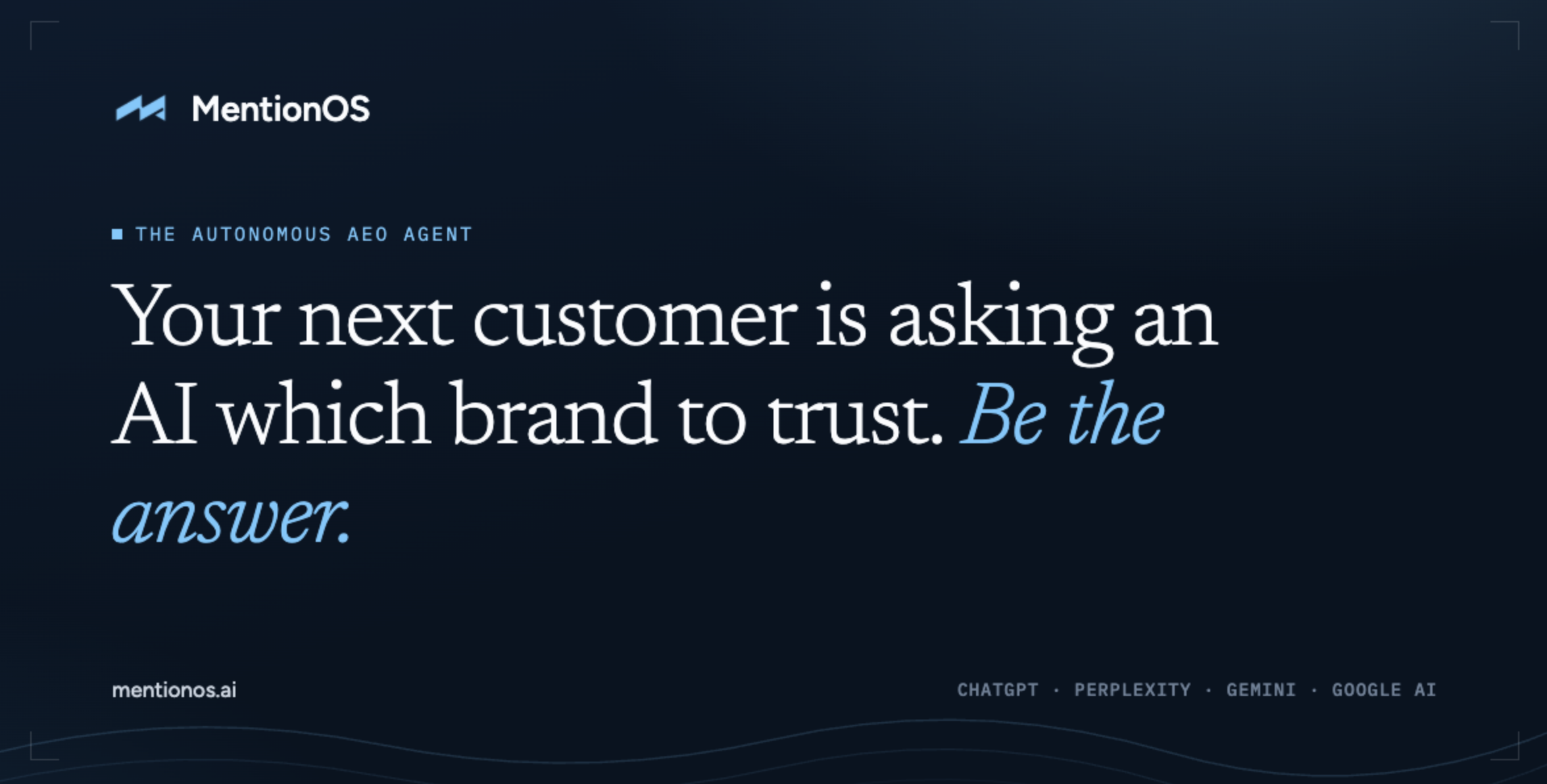
MentionOS is an autonomous AEO agent that monitors AI answers from ChatGPT, Gemini, Perplexity and Google AI, identifies visibility gaps for brands, drafts content and technical suggestions, and can publish automatically to connected blogs. Source ↗
What it does
- Daily monitoring of AI answers across multiple models ↗
- Drafts articles and technical remediation suggestions ↗
- Autopilot mode that writes, schedules and publishes to a connected blog ↗
- Integrates with Shopify, WooCommerce, Webflow, Framer and WordPress ↗
- Provides visibility reports and alerts on changes ↗
- Allows review and approval of content before publishing ↗
Founders
No founder identity verified from the sources reviewed.
Funding timeline
No verified public funding round found. This does not mean the company is unfunded.
In the news
No attributable press or commentary found in the sources reviewed.
Podcasts
Founder appearances, with public episode sources. An appearance may cover another company or a broader topic; it is not an endorsement.
No sufficiently attributable podcast appearance found in the sources reviewed. This is not proof that no appearances exist.
Company profile:
Startup name: MentionOS
Tagline: The autonomous agent for AI search visibility
Elevator Pitch: MentionOS is an autonomous AEO agent that gets brands named in AI answers. It monitors ChatGPT, Gemini, Perplexity, and Google AI, identifies visibility gaps, creates citable content, and publishes it automatically.
Target Market: Brands, e-commerce businesses, marketing teams, SEO professionals, agencies, content marketers, and companies seeking visibility in AI-generated search results
How will you make money?: $79/month (Beta) or $790/year
How much capital have you raised?: None
Website: https://mentionos.ai/
City/Country: United Kingdom
AI-assisted summary:
MentionOS is a UK-registered B2B software service that positions itself as an autonomous answer-engine-optimization (AEO) agent for brands seeking visibility in AI-generated answers. (Source: https://mentionos.ai/terms) Its core proposition is to monitor how ChatGPT, Perplexity, Gemini and Google AI respond to category questions, explain changes in a brand’s visibility, and help execute content and technical actions intended to improve that visibility. (Source: https://mentionos.ai/)
The problem and target users
The startup is aimed at businesses whose prospective customers increasingly ask AI systems for product and category recommendations rather than relying solely on conventional search-result pages. (Source: https://mentionos.ai/) MentionOS specifically identifies SMB brands and agencies as intended users, while a recent company launch announcement describes its focus as founders and marketing leaders at SMB and midmarket consumer and B2B businesses with limited in-house AEO capacity. (Source: https://mentionos.ai/) (Source: https://www.cantechletter.com/newswires/mentionos-ai-launches-an-autonomous-aeo-agent-that-analyzes-what-chatgpt-gemini-and-other-llms-say-about-brands-then-helps-get-them-mentioned/)
The practical challenge is not simply measuring whether a brand appears in AI answers, but continuously interpreting volatile outputs across multiple models and translating those findings into work that a lean marketing team can actually complete. (Source: https://mentionos.ai/) MentionOS differentiates its approach from dashboard-led visibility tools by presenting the product as an operating agent that monitors, analyzes and proposes or performs approved follow-up work. (Source: https://mentionos.ai/)
Product and solution
MentionOS says its agent performs daily monitoring of answers from ChatGPT, Perplexity, Gemini and Google AI, tracks competitors mentioned in those answers, and reports what changed and why. (Source: https://mentionos.ai/) Its terms further specify that the service can monitor category questions, interpret results, draft articles, and produce technical remediation suggestions such as robots.txt directives, llms.txt files and structured data. (Source: https://mentionos.ai/terms)
The product’s execution layer is centered on a brand’s own site. (Source: https://mentionos.ai/) In its default review mode, customers approve proposed content before publication; customers can alternatively authorize an autopilot mode that writes, schedules and publishes articles to a connected blog. (Source: https://mentionos.ai/) The company says the product can work with platforms including Shopify, WooCommerce, Webflow, Framer and WordPress, while communication can continue through the app, email and connected channels such as Slack. (Source: https://mentionos.ai/terms)
This approval design is significant because MentionOS’s own terms state that customers remain responsible for material published on their sites and should review drafts before they go live. (Source: https://mentionos.ai/terms) The same terms caution that third-party AI models are probabilistic and may change without notice, and explicitly say MentionOS does not guarantee a mention, citation, ranking or position in an AI answer. (Source: https://mentionos.ai/terms)
Business model, pricing signals and traction
MentionOS advertises a founder price of $79 per month, or $790 annually, with a free audit that does not require a payment card. (Source: https://mentionos.ai/) Its terms say subscriptions renew automatically until cancelled and that founder or beta rates can apply for as long as a subscription continues without interruption. (Source: https://mentionos.ai/terms)
The company also states that parts of the service are beta features, meaning they may contain defects and can be modified or withdrawn. (Source: https://mentionos.ai/terms) Public materials reviewed for this overview did not provide independently verifiable customer counts, revenue, funding or performance outcomes, so those indicators should not be inferred from the company’s illustrative product examples. (Source: https://mentionos.ai/)
Expert take
MentionOS’s strongest positioning is its attempt to turn AEO from an analytics workflow into an execution workflow for resource-constrained teams. Its low published entry price and human-approval controls could make the offer accessible to smaller brands, but the product’s ultimate value will depend on whether it can demonstrate reliable, measurable improvements despite AI-answer volatility and its lack of control over underlying model behavior.
Note: Information based on publicly available sources at the time of writing, and summarized by AI.
Keep your curiosity moving.
Discover the Startup88 newsletter →