Wisegrid
● AI-extracted profile · Editorial review pending. Check the linked sources before relying on these details.
Founders
- Ryan KramerFounder
Funding timeline
No verified public funding round found. This does not mean the company is unfunded.
In the news
No attributable press or commentary found in the sources reviewed.
Podcasts
Founder appearances, with public episode sources. An appearance may cover another company or a broader topic; it is not an endorsement.
No sufficiently attributable podcast appearance found in the sources reviewed. This is not proof that no appearances exist.
Company profile:
Startup name: Wisegrid
Tagline: Work management on a spreadsheet you already know
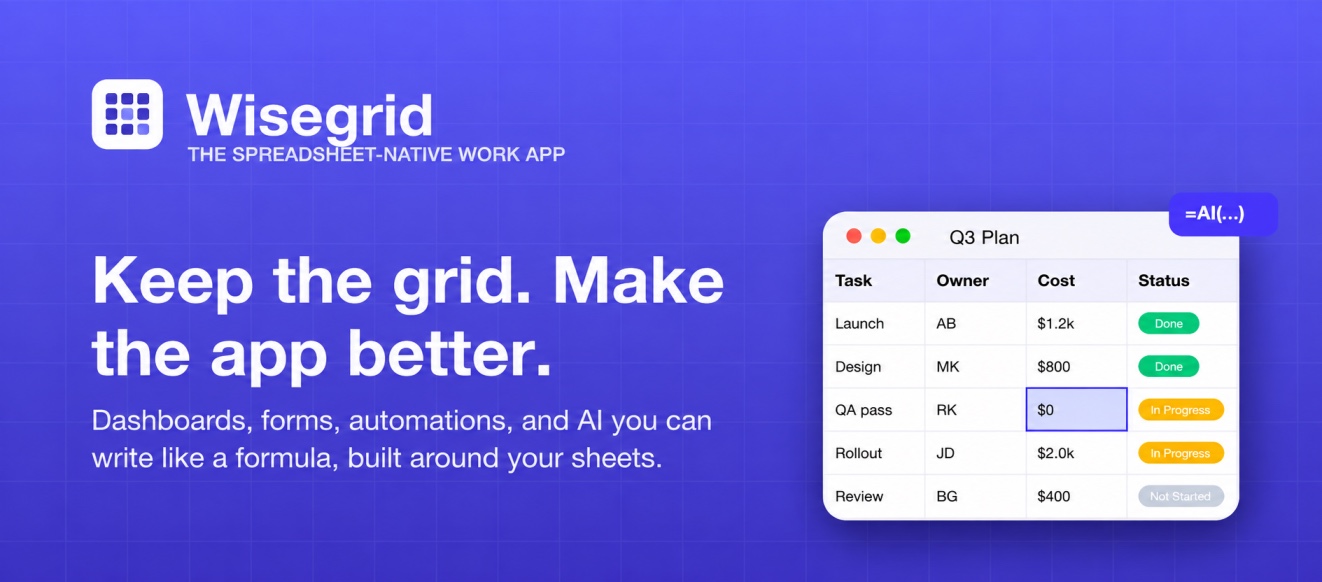
Elevator Pitch: Wisegrid is a spreadsheet-native work management platform for project-driven teams that need more structure without giving up the flexibility of a familiar grid.
It combines rows, columns, formulas, hierarchies, and cross-sheet references with dashboards, Gantt, board and calendar views, forms, workflow automation, approvals, resource planning, and real-time reporting. AI-powered formulas also help teams classify information, extract key details, and summarize project data directly inside the workspace.
Target Market: USA
How will you make money?: null
How much capital have you raised?: null
Website: https://wisegrid.co/
City/Country: USA
AI-assisted summary:
Wisegrid is a work-management application built around the familiar spreadsheet grid, positioning rows and columns as the operational source of truth while adding dashboards, reporting, forms, automations, permissions, and AI-assisted formulas. (Source: https://wisegrid.co/)
The product matters because it targets teams that already run real processes in spreadsheets but need more structured collaboration and reporting without forcing users into a wholly different project-management interface. (Source: https://wisegrid.co/)
Problem and target users
Wisegrid is aimed at people and teams that “track work in a grid,” including project, product, resource-planning, construction, and marketing users identified in its published use-case materials. (Source: https://wisegrid.co/) (Source: https://wisegrid.co/features/)
Its central premise is that teams often maintain work in sheets, then separately build dashboards and status reports, creating duplicated reporting work and a risk that reporting falls out of sync with the underlying tracker. (Source: https://wisegrid.co/)
The company also appears to be targeting organizations evaluating an alternative to Smartsheet: its migration flow is designed to import selected Smartsheet workspaces, folders, sheets, formulas, attachments, forms, and reports using a read-only API token. (Source: https://wisegrid.co/migrate)
Product and solution
Wisegrid keeps the spreadsheet metaphor at the center of the product, offering Excel-compatible formulas, cross-sheet references, row hierarchies, multiple column types, and sheets with capacity for up to one million cells. (Source: https://wisegrid.co/) (Source: https://wisegrid.co/features/)
On top of the grid, it offers live dashboards and reports, Gantt timelines, branded multi-step forms, row-level comments and attachments, role-based sharing, and visual automations triggered by row changes, new rows, or dates. (Source: https://wisegrid.co/features/) (Source: https://wisegrid.co/features/automations)
Its automation tooling includes conditional actions such as notifications, assignments, cell updates, and moving or copying rows, plus approval steps that pause a workflow until an approver makes a decision. (Source: https://wisegrid.co/features/automations)
Wisegrid also embeds AI functions in spreadsheet cells, including functions for classification, extraction, summarization, and a general-purpose =AI() formula; the company says usage is metered against a monthly credit allowance with a hard spending ceiling. (Source: https://wisegrid.co/) (Source: https://wisegrid.co/pricing/)
For technical teams, Wisegrid publishes a versioned REST API with scoped API keys and endpoints for reading sheets and rows and writing rows individually or in bulk. (Source: https://wisegrid.co/docs/api)
Business model, pricing signals, and traction
Wisegrid uses a simple seat-based SaaS model: it lists one plan at $19 per editor per month, with view-only collaborators free and a seven-day trial that does not require a credit card. (Source: https://wisegrid.co/pricing/)
The listed plan includes features that competing work-management vendors often reserve for higher tiers, such as automations, dashboards, Gantt views, enterprise SSO, MFA, AI credits, and the Smartsheet importer. (Source: https://wisegrid.co/pricing/)
Public materials identify Ryan Kramer as founder and describe Wisegrid as built openly by a solo founder, while Kramer’s LinkedIn profile has described the product as a Smartsheet replacement. (Source: https://wisegrid.co/) (Source: https://www.linkedin.com/in/ryankramer2)
The reviewed public sources do not provide independently verifiable customer, revenue, funding, or adoption figures, so Wisegrid should be assessed as an early-stage product rather than on demonstrated scale. (Source: https://wisegrid.co/) (Source: https://www.crunchbase.com/organization/wisegrid-co)
Expert take
Wisegrid’s strongest positioning is its attempt to preserve spreadsheet familiarity while consolidating the surrounding workflow layer—reporting, intake, approvals, and collaboration—into the same system.
The transparent, editor-only pricing and migration emphasis could resonate with spreadsheet-heavy teams frustrated by per-seat complexity or disruptive tool changes. The main diligence question is execution: the product has a broad feature surface, but public evidence of market traction remains limited.
Note: Information based on publicly available sources at the time of writing, and summarized by AI.
Keep your curiosity moving.
Discover the Startup88 newsletter →