Octuo
● AI-extracted profile · Editorial review pending. Check the linked sources before relying on these details.
Octuo is a personal assistant for work across AI, tools and specialist services, coordinating connected, authorized tools and accounts, carrying context, tracking progress and gathering results around a goal. Source ↗
What it does
- Persistent memory with a knowledge graph covering people, projects and decisions ↗
- Desktop action using Screen Recording and Accessibility permissions to perceive and act on the Mac ↗
- Encrypted Secrets Vault for credentials, API keys and tokens ↗
- Supports multiple AI model providers (OpenAI, Anthropic, Google, xAI) ↗
Founders
No founder identity verified from the sources reviewed.
Funding timeline
No verified public funding round found. This does not mean the company is unfunded.
In the news
No attributable press or commentary found in the sources reviewed.
Podcasts
Founder appearances, with public episode sources. An appearance may cover another company or a broader topic; it is not an endorsement.
No sufficiently attributable podcast appearance found in the sources reviewed. This is not proof that no appearances exist.
Company profile:
Startup name: Octuo
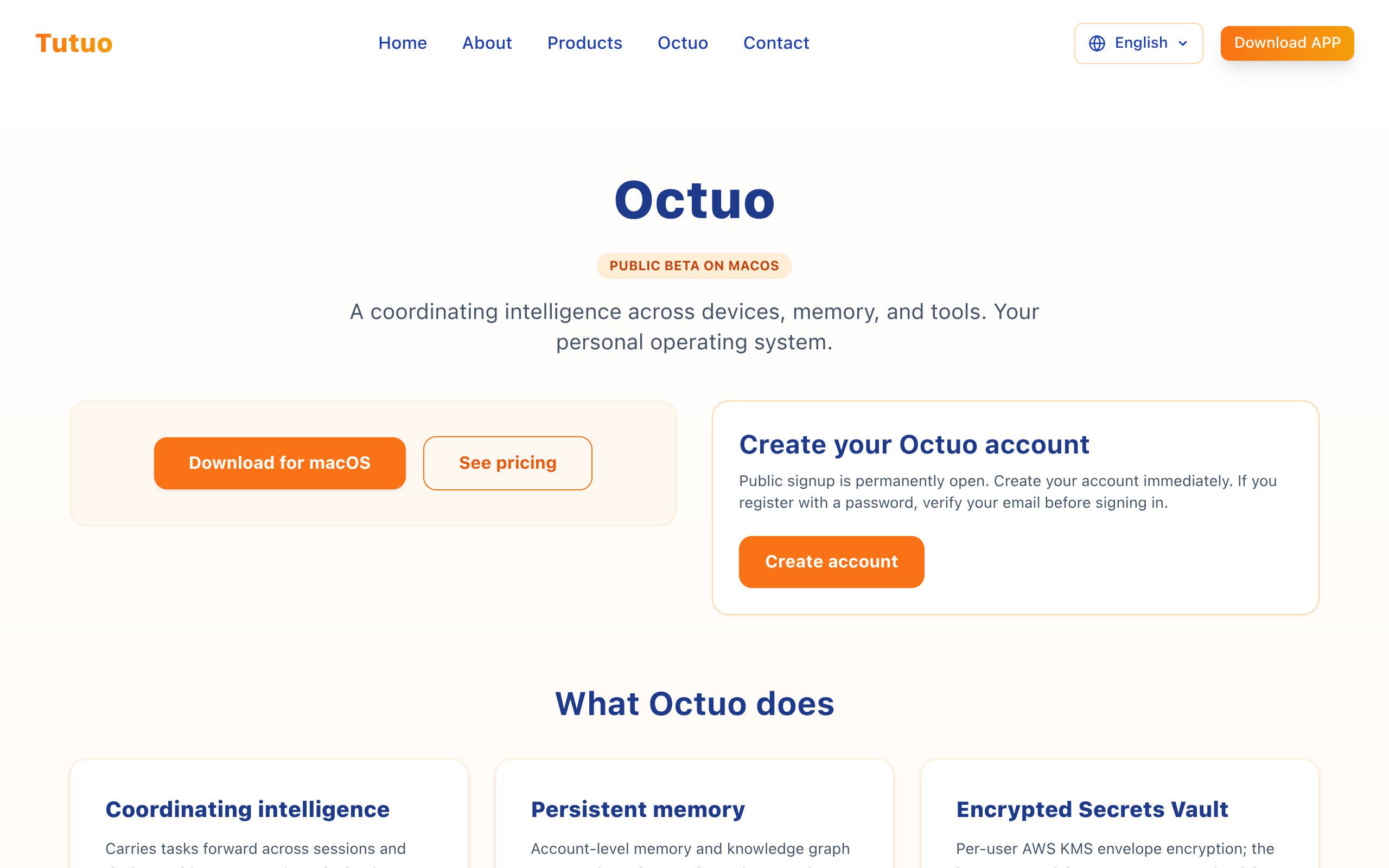
Tagline: Your personal assistant. Your AI and tools, working together.
Elevator Pitch: Octuo is your personal assistant for work across AI, tools and specialist services. It coordinates connected, authorized tools and accounts, carries the context each task needs, tracks progress and gathers results around your goal. Public beta on macOS; paid, credit-based.
Target Market: AI productivity users, knowledge workers, professionals, and tech-savvy individuals seeking an integrated personal AI workspace.
How will you make money?: Paid, credit-based usage.
How much capital have you raised?:
Website: https://www.tutuo.ai/en/octuo/
City/Country:
AI-assisted summary:
Octuo is a public-beta desktop AI assistant from Tutuo, Inc. that positions itself as a “personal operating system,” designed to coordinate a user’s devices, memory, knowledge, and tools rather than operate as a standalone chat interface. (Source: https://www.tutuo.ai/en/octuo/) The product matters because it is attempting to combine persistent personal context with desktop-level action, an ambitious category where convenience, trust, and permission design are equally important. (Source: https://www.tutuo.ai/en/octuo/download/)
Problem and target users
Octuo addresses the fragmentation of modern knowledge work: tasks, decisions, credentials, and conversations are typically scattered across apps and are often lost between separate AI sessions. Tutuo says Octuo carries tasks across sessions and devices, while maintaining account-level memory and a knowledge graph for people, projects, and decisions. (Source: https://www.tutuo.ai/en/octuo/)
The initial target user appears to be an individual Mac user who wants an AI assistant to see desktop context and act within authorized workflows. Octuo requires macOS Screen Recording and Accessibility permissions so it can perceive the screen and interact with the desktop, and its current build requires macOS 14 or later; Apple Silicon is recommended, while Intel Macs are not currently supported. (Source: https://www.tutuo.ai/en/octuo/support/)
This is not positioned as a conventional team SaaS platform or a narrow automation tool. Instead, Tutuo describes Octuo as a personal layer that can coordinate devices, personal knowledge, long-term memory, and tools. (Source: https://www.tutuo.ai/en/investors/)
Product and solution
Octuo’s core proposition is persistent coordination: it is intended to retain context across conversations and devices, rather than requiring users to repeatedly restate project details or task history. (Source: https://www.tutuo.ai/en/octuo/) The desktop application is cloud-connected for most model calls, meaning it is not a fully local AI product despite its desktop delivery model. (Source: https://www.tutuo.ai/en/octuo/download/)
- Persistent memory: Tutuo says Octuo maintains account-level memory and a knowledge graph covering the people, projects, and decisions important to a user. (Source: https://www.tutuo.ai/en/octuo/)
- Desktop action: The Mac app uses Screen Recording and Accessibility permissions to perceive on-screen information and act on a user’s behalf. (Source: https://www.tutuo.ai/en/octuo/download/)
- Credential handling: Its Secrets Vault is designed for credentials, API keys, OAuth tokens, SSH keys, and cloud access keys; Tutuo says credentials are encrypted and that the language model receives a handle rather than the raw secret. (Source: https://www.tutuo.ai/en/octuo/account/vault/)
- Multi-model infrastructure: Octuo’s privacy documentation lists OpenAI, Anthropic, Google, and xAI among AI providers that may process prompts and system context when their respective models handle a request. (Source: https://www.tutuo.ai/en/octuo/legal/privacy/)
There are important limits to the security story. Tutuo explicitly describes the Vault as “beta-grade,” notes that its backend can decrypt credentials for authorized operations, and advises users not to store credentials they cannot afford to lose. (Source: https://www.tutuo.ai/en/octuo/legal/beta-notice/)
Business model, pricing signals, and traction
Octuo uses a subscription-plus-usage model based on Neural Token Units (NTUs), which the company describes as its internal credit currency; one NTU is stated to be approximately $0.001. (Source: https://www.tutuo.ai/en/octuo/pricing/) Listed subscriptions start at $9.99 per month for 6,000 NTUs, rise to $29 per month for 24,000 NTUs, and reach $199 per month for 170,000 NTUs, with one-time credit packs available for additional usage. (Source: https://www.tutuo.ai/en/octuo/pricing/)
The product is publicly available in beta for macOS, but Tutuo warns that features, uptime, and pricing may change during this stage. (Source: https://www.tutuo.ai/en/octuo/support/) No customer, revenue, funding, or usage figures were identified in the company’s public Octuo materials reviewed for this overview.
Expert take
Octuo’s strongest differentiation is its attempt to unite memory, desktop agency, and credential-aware tooling in one personal product rather than treating AI as an isolated chat tab. The main execution risk is also clear: users must grant meaningful permissions and trust a beta product with highly sensitive personal context. Its ultimate position will depend less on the “personal OS” label than on whether it can make agent actions reliably useful, inspectable, and safe enough for everyday work.
Note: Information based on publicly available sources at the time of writing, and summarized by AI.
Keep your curiosity moving.
Discover the Startup88 newsletter →